Showing posts with label A Brief History Of.... Show all posts


La Cocina Espanol: A Brief History of Paella

My favorite line in Penelope Casa's The Food and Wines of Spain (aka my and Dave's foodie bible while traveling) is a quote from a Spanish food critic in response to canned paella:

"Canned paella?! How can you can paella? It's like trying to can the sun...or poetry!"

Spaniards take their paella seriously, and reading Casa's book, I learned to take it seriously, too. The paella rules? ONLY to be eaten where you can see the ocean, ONLY in Valencia--Spanish rice country, and ONLY with fish and seafood that was swimming about 30 seconds prior to dropping in the pan. She also strongly encouraged readers to seek out paella made directly on the fishing boats where the fish are caught, a process that places so much emphasis on freshness that even sitting in a restaurant is too far away and paella purists must instead gather on the beach like waiting seagulls. However even she contended that this was maybe going a little too far.

Paella was born in Valencia, where the ubiquitous rice paddies dot an otherwise arid region. Named for the Catalan word for pan, paella is seasoned with saffron, a spice found in many Spanish dishes due to the Moorish influence in the country. Although I was most anxious to try seafood paella, the dish's popularity throughout Spain means there are myriad varieties, from Valenican paella, which is made with rice, beans, green vegetables, and meat, to paella flavored with chicken or lobster. A sign of a good paella is that it's served directly in the pan in which it was cooked, rather than scooped up from a communal pot. The paella should be crispy on the bottom, and warm throughout, cooked together with the rice and meat or seafood to allow the flavors to properly mix.

The first time I went to Spain, when I was 16 (I think? oh memory), my family and I ate paella at an outdoor restaurant in Madrid. It was not pleasant. Although you can smoke pretty much anywhere anytime in Europe, outdoor eating tends to attract the greatest plumes of smoke, and I was unfortunately sitting behind a woman who courteously blew her smoke away from her tablemates and onto my face. After I convulsively hacked away, she eventually realized what was happening, apologized, and stopped, but my first memories of paella are mostly clouded (heh) by that unfortunate experience. Later, I would learn that in breaking all the paella rules, the giant pan my family dug into with gusto was, in all likelihood, subpar. I think I probably ordered chicken anyway.

So when Dave and I arrived in Spain, I vowed to make amends and give paella another try. Valencia was on our list of places to visit, but at the last minute we decided to veer off for a day trip to France (we ended up driving for many, many hours, seeing a castle, and spending a night in a very hot and very cheap hotel). Although I was disappointed I couldn't sample (and steal) some of the long-grained Spanish rice Casa rhapsodized in her book, my dreams of eating paella cerca del mar were revived our last few nights in Spain, when we visited the city of Tarragona.

Tarragona, a Catalan city built by the Romans, sits on the Mediterranean a few hours north of Valencia. Although it lacks Valencia's famous rice paddies, it's full of wonderful seafood places, which means paella is almost a requisite for most restaurants. We visited one our first night there, where Dave finally got his pulpo (octopus. I know.) and I dug into a plateful of paella. My first impressions were not so great. It tasted mushier than I'd thought it would, with the rice thicker and more like risotto. The restaurant also skimped on the seafood, decorating the dish with lovely--and empty--cockle shells. I took that to mean I could do better, and so I don't hold the world of paella responsible for my two less than pleasant meals.

Still, even through the paltry seafood and the sticky rice, I could taste faint glimmers of loveliness. The rice, flavored with saffron, had brief moments where it was comfortingly warm and fragrant, filling without being weighty. Paired with fresh, fresh seafood--rich, sweet, faintly alive seafood--I saw how the dish could really taste. If anything, my disappointing meal has left me even hungrier for real paella, a shame since Casa is unsurprisingly disdainful of American mock-ups. Such is the price of perfection!
Read more!


La Cocina Espanol: A Brief History Of Sidra

Although my year+ of working at a pub taught me to appreciate beer in ways no college-kid kegger could, it's still not the first thing I reach for at a bar. I'm not quite the girly-girl smackin' on her Smirnoff Raspberry or downing appletinis (unless I'm at a Scrubs theme party), but I might lean towards a white wine if it's a nicer place or maybe a Sam Summer if we're in Boston.

So I was intrigued when we got to Basque country and Dave started talking about sidra, a hard cider native to the region. I like American hard cider (I favor Original Sin), but I was completely blown away by sidra and could have happily smuggled bottles and bottles of the stuff through customs had I not been scared by Rebecca's story of her own attempts to transport beer (smashed bottles, alcoholic luggage, angry fellow passengers). It was less sweet than American hard cider, but tangier, fresher, and more bitingly alcoholic--I could have had it breakfast, lunch, and dinner, and probably would have, too, as the siderias where it's served were open all day.

My love for sidra is so profound that I was not even terribly embarassed by my and Dave's sidra faux pas the first time we drank it. We had arrived in San Sebastian, a coastal town not far from Bilboa, and exhausted and hungry, asked the hotel to direct us to the closest bar. Muching on pinchos (sandwiches), we asked the bartender for a bottle of sidra. He obligingly got one from the fridge, uncorked it, and stuffed a small green spout in the mouth. Dave immediately removed the spout, poured our drinks, and we clinked glasses and enjoyed. It tasted good--refreshingly appley if a little flat--and we finished the bottle, paid our check, and headed back to the hotel, not even questioning what that little spout was for.

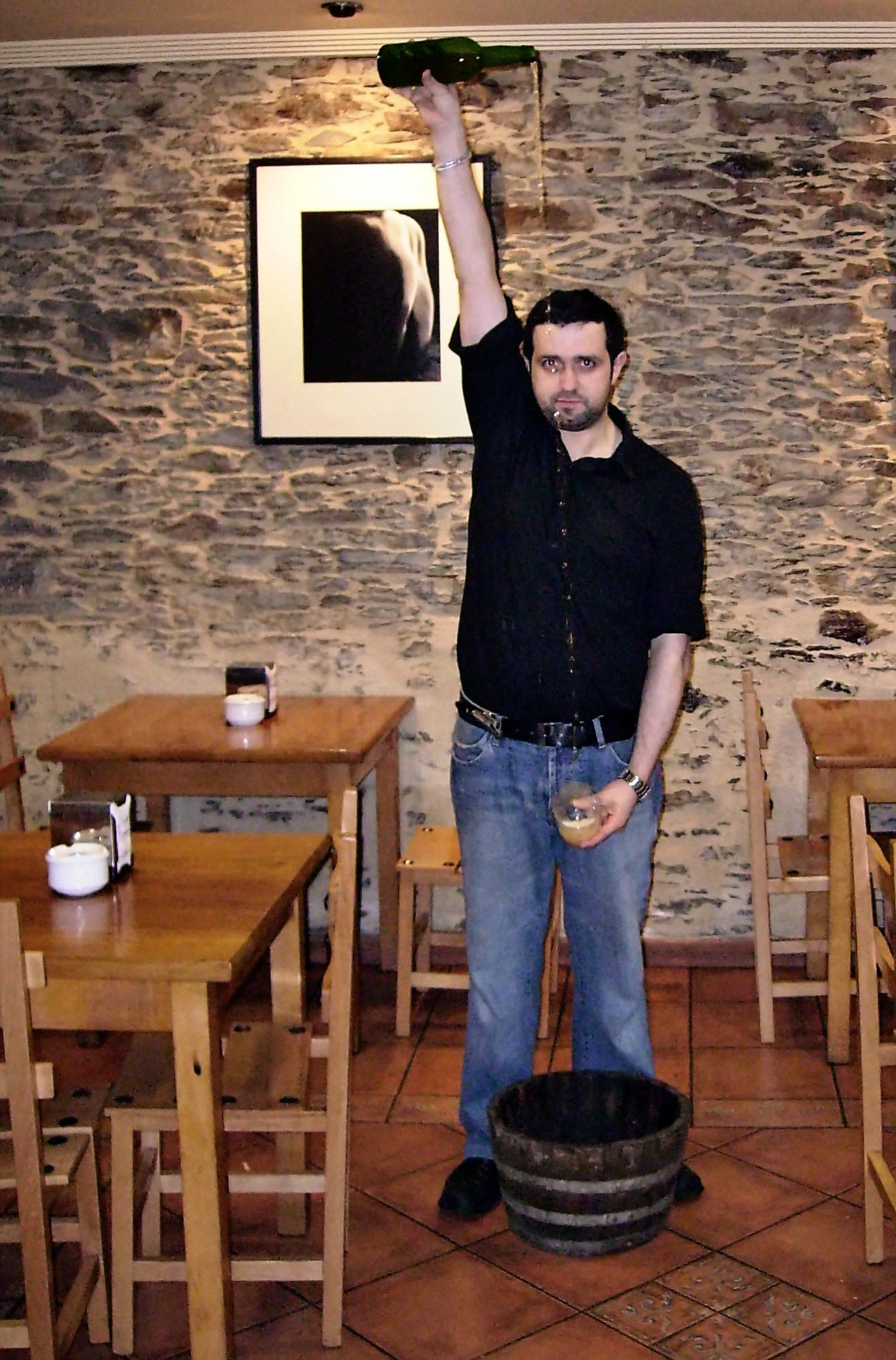
Days later, we discovered our error: sidra, as enjoyed in Basque country, is poured into a glass held about 3 feet away from the bottle. Once it splashes in the glass (if you're good enough to actually aim it into the glass), it releases tiny bubbles that churn the cider, unleashing a flood of rich, unique taste. The difference between our quietly poured glasses and the fizzing, splashing, correctly-poured sidra was like the difference between flat Coke and regular--no comparison, it was just so much better. The bubbling added a rich texture and complexity of flavor, allowing the odor of fresh apples to better reach your nose. While sidra on its own is pretty good, fizzy, bubbly, messy sidra is utterly amazing.

Like any good regional drink, the amount of care and thought put into crafting, pouring, and enjoying sidra was amazing. In Asturias, we came across strange contraptions with shelves and hoses mounted to the walls of bars. Asking for a glass of sidra, we saw the thing in action: a machine designed to fizz up the drink and drop it into the glass without making a giant mess. Because the truth is, sidra is messy to drink. The precision needed to pour it into a glass is ridiculous (for days I thought it couldn't be that hard, until Dave allowed me to try it a few times. About three drops landed in the glass), and even pros concede a few splashes will hit the floor. If it wasn't so delicious, I would have even wondered whether the pour from above thing was just a ruse made up by enterprising siderias that wanted to sell more bottles--afterall, you lose at least a glass of the stuff through pouring.

Because sidra is made only in special farm/restaurants called sagardotegi, it's not sold in the U.S. or even in most parts of Spain. Bottled, it can last about a year, but since it must stay cool, it's almost exclusively drunk in northern Spain (some Basque restuarants will serve sidra, though, like one we found in Tarragona). Still, if you do make it up to the northern regions of Spain, sidra will almost certainly be the most popular drink available, bubbling and fizzing its way into your heart.
Read more!


A Brief History Of: Sherbet (not sherbert)

While ice cream will always melt my heart (get it?), my absolute favorite cold-dessert delight is sherbet.* Specifically, rainbow sherbet, in a sugar cone, topped with rainbow sprinkles. I'm not sure what it is about this that so completely enthralls me, but I can't get enough of it--simple, sweet, colorful, and refreshing. Exactly what I want to eat on a hot summer night, or afternoon, or morning. Or, you know, right now.

When I was a kid, my mom would buy a giant plastic container full of sherbet, which I would steadily work through during the entire summer. A few days ago it dawned on me that I am, technically-speaking, an "adult" with actual purchasing power (hello consumer stimulus!) and that I too could buy myself a huge tub of sherbert (not too much power needed--the whole thing cost about $3.99). And when I say "huge," "giant," I am not kidding: the container is the size of a large dinner plate and about 6 inches deep. It is currently living in my freezer, where it is like a hulking, intimidating Russia surrounded by cowering Hawaiis of Haggen-Das.

Sherbet is not to be confused with sorbet, at least in my opinion (we'll win over those pesky FDA snobs some day...). The main difference is milk fat content. Both are made with water, sugar, and fruit juice or puree, but sherbet is also mixed with dairy products, having milkfat of less than 3%. While the Food and Drug Administration maintains that sorbet and sherbet are essentially the same things (a tricky distinction for interstate food laws--no joke), if you've ever sat in a restaurant or at an ice cream truck and wondered what was the difference, there you go.

The origins of sherbet stretch all the way back to Roman days, when cah-razy emperor Nero decided to serve some delicious cool dessert for a banquet. He had his genial slaves carry buckets of snow from the mountains, then doused the ice in honey and wine (this is the same guy who danced while Rome burned. Foodies are so weird). According to Encarta (and isn't that a blast from the Windows 95 past. Remember "MindMaze"? That game rocked. But I digress...), "sherbet" has origins in an Arabic word, sarbat (also the origin of the word "syrup"), and was originally a popular Middle Eastern drink. It eventually worked its way through Persian and Turkish route before ending up in Europe (English: sherbet, French: sorbet, Italian: sorbetto).

Legend has it that sherbet made the jump from drink to frozen concoction when a glass of the stuff was accidentally chilled. In America, ice cream goes back to at least the 1700s, with Dolly Madison introducing the dessert to the White House in 1812. One of the first recorded recipes for sherbet in America dates back to 1905, when Mrs. E.H. Williams submitted her cranberry sherbet recipe to the Los Angeles Times. According to Wikipedia, rainbow sherbet (my fave) was invented by Emanuel Goren in the late 1950's, while he worked at Sealtest Dairies in Philadelphia. Goren developed and popularized the three-nozzle system that gave rainbow sherbet its characteristic marbleized color and flavor.

Now, sherbet is an American staple, sold in ice cream parlors and hot sidewalks around the country. Its bright colors and creamy texture make it perfect for popsicles or recreating charming children's characters in an alarming fashion.


*Sherbet is commonly misspelled with an extra "r," as "sherbeRt," possibly because, when translating "sorbet" to English, Americans were more comfortable pronouncing words ending in -bert (Herbert, Robert, Albert...) than -bet (....). This note is not meant to be condescending because I, obviously, also misspelled it until caught by spellcheck. Stupid American English.
Read more!


A Brief History Of: Uh Oh Spaghetti Os!

It's always nice when the food you eat inspires poetry:
Oh, dear humble SpaghettiO,
Your round delight, the straight-line's foe,
Your sauce, your cheese, your hearty glow,
The truth--it's true!--I love you so.*

Yes, the SpaghettiO, because who said spaghetti had to come in a straight line? I am usually wary of food that comes in a can, but I happily make an exception for SpaghettiOs, which are the reason I learned how to use the electric can opener when still in the second grade. Little round circles of pasta (three sizes!), suspended in a cheesy tomato sauce, always emerged hot and delicious from the microwave. I probably loved SpaghettiOs a little too early for a little too long (I don't have any in my pantry right now, but that's because the grocery was only selling Spiderman-shaped SpaghettiOs...), but for good reason! They are simple, delicious, and--years of Franco-American brainwashing tells me--healthy!

No, but really, let's take a walk down memory lane.

SpaghettiOs' origins, like those of all Great American Heros, are shrouded in mystery. Were they the 1884 creation of an Italian-American family named Kirby (suspicious: Kirby does not sound Italian) or a product of the 1960s, when Franco-American decided to release the ringed pasta? I don't know, and Google is presenting differing histories... (what are they trying to cover up???)

Here's what we do know: SpaghettiOs were first made under the auspices of Franco-American, bought by Campbell's in 1915. The little Os are a mixture of different pastas, anelli, anellini, and occhi di pernice if you believe Wikipedia, or, according to the Franco-American Kidz Fun Facts website, ditali, ditalini, tubetti, and tubetini. SpaghettiOs come in 4 different varieties: plain, meatballs, franks, and extra calcium (whatever that means), although--Fun Fact!--the meatball version actually has no meat in it, as anyone who has ever eaten the meatball version could tell you.

When they were released in 1965, they were branded as the solution to the perenial problem of cheerful babies dumping bowls of spaghetti on their heads. Franco-American said the little Os were easier and less messy to eat, and sold their point by advertising on napkins. But they really shot to popularity when teed idol Jimmie Rodgers (not this Jimmy Rodgers) recorded the now-famous "Uh Oh SpaghettiOs!" song. Dear reader, the lyrics:
The neat round spaghetti you eat with a spoon,
Uh Oh, spaghetti os.

Starting in 1980, SpaghettiOs teamed up with animation studios to feature cartoon-shaped pasta, including Garfield (who probably would have preferred being turned into lasagna), Gargoyles (who remembers them?), and Waldo (rebranded as WaldO, natch). Since then, I've seen just about every kiddie cartoon get the SpaghettiO treatment, something I'm not too happy about. Not only is it distressingly hard to discern the difference between Dora the Explorer and Ren & Stimpy SpaghettiOs, but there was always something off about the cross-hatched taste of those weird little shapes.

This is the part of the post where I usually write about a personal recipe I use incorporating the briefly-historicized food, but the only recipe I generally follow when making SpaghettiOs is open can, dump into bowl, add heat, enjoy. Luckily, thanks to the magic of the Internets, I discovered an article by Trent Sandusky called "X-TREME Spaghetti-Os: Enhance Your Canned Pasta (and Your Life!)". Trent, who writes "I started out small: green peppers, diced onions, chocolate chips. The chocolate chips were a bad idea, but progress never comes without a price," seems to be a chef/blogger after my own heart. Branding himself an Expert-O!, he presents 5 SpaghettiO-centered recipes with the kind of cheerful abandon for clashing tastes and affronted sensibilities that I strive for in my own recipes. I like the SpaghettiO pizza (although Trent appears to like it too much) and adapted the recipe for actual human consumption.

SPAGHETTIO PIZZA
INGREDIENTS
1 pizza crust, either fresh or frozen (be sure to defrost)
1 can plain or meatball SpaghettiOs
1 1/2 cup shredded mozzerella

DIRECTIONS
Preheat oven to 375 degrees
Spread unheated SpaghettiOs onto pizza crust
Sprinkle evenly with mozzerella
Bake for 30-40 minutes, or until mozzerella is completely melted

*Shocking that I don't get paid to write this blog, eh?
Read more!

A Brief History of: Popcorn

One of the secrets of the big beautiful multi-national company I work in is that, almost any time of the day, they serve giant bowls of delicious popcorn. I don't know how they do it, but it is always lovely: fresh and delicious, giant salt flakes, no butter but still light and flavorful. Every once in a while they serve some gourmet variations--usually from Ike & Sam's--that are bizarre and delicious (like cheddar kettle corn and kickin' cayenne) and once I went to a company-sponsored film screening in Central Park where they served caramel-Oreo-cookies popcorn (oh heaven), but generally I stick to the tried and true: plain, lightly salted, delish.


And why not? People have been snacking on popcorn for 4,500 years! The earliest popcorn cobs, found in a cave in Mexico, were probably used both as food and decoration (like ancient preschool Christmas tree decorations!). Native Americans, who introduced popcorn to Europeans, thought the pop the corn made was an angry god being released. After burning many bags of popcorn in my day and seeing a black, twisted, smoldering pile of gunk eat through my microwave, I can understand this idea. Popcorn was at the first Thanksgiving, in addition to popcorn soup and beer, and was crucial to the survival of those comically-inept farmers, the Puritans (when my second grade class reenacted the first Thanksgiving, we had our own popcorn popping ceremony, whereupon the astonished Pilgrims gasped as mere corn was transformed. Of course, this was in the 90s, and my teacher used Pop Qwiz, the popcorn that came in neon colors, so I always kind of thought the astonishment was more about Day-Glo food than the popcorn itself...).

In the 1700s, people began using oil for popping, replacing the previous method of sticking the whole cob over a fire. No knocks to popcorn beer, but soon people added salt and sugar to popcorn, even putting it in milk for Colonial-style cereal. The first commercial popcorn makers were developed by Charles Creators, who brought the popcorn cart to the street in the late 1800s. Popcorn exploded (heh) in popularity during the Great Depression, when 5-10-cent bags made cheap and easy snacks for cash-strapped Americans. When World War II led to sugar rations, people consumed 3 times as much popcorn to get their snack fix. Since then, popcorn remains a cheap, healthy, and easy-to-find snack, delighting movie-goers and dieters worldwide.

And ok, popcorn is healthy in its pure state--sugar free, low in sodium and calories, and high in fiber. Less healthy: movie theater popcorn, which is essentially a bucket of oil with some kernels floating along helplessly. A 1990s report from the Center for Science in the Public Interest found that a medium-sized portion of popcorn contained more fat than "bacon and eggs, a Mac and fries, and a steak dinner combined." A small size of popcorn contains 29 grams of saturated fat, about as much as three Big Macs. Yum. Still, butter and oil-less, popcorn is a healthy snack.

I don't really like movie theater popcorn. Something about it just makes me feel greasy (maybe the massive quantities of butter and oil?), and I always feel vaguely sick after eating it. Granted, buttered popcorn smells dreamy, being the kind of thing that always attracted a flock of hangers-on whenever someone made it in high school, but after a while my tongue feels like it has been shellacked in artificial butter, and I just had to give it up. The problem then, is that people don't really make microwaved popcorn with no flavoring ("Light Butter" is usually the best you can get), giving the popcorn-hungry no choice but to turn to their own devices.

Home popping is one of those things that is best described in Little House on the Prairie-terms, with Ma hauling out the old dutch oven and Laura and Mary patiently waiting for the pop pop sounds as Pa pulls out his fiddle. Minus the fiddle, actual home popping is not too different. I use pot and oil, although what I really want is one of those nice air poppers that will last me the next thirty years. The technique is easy enough: oil, deep pot, heat, kernels, enjoy. Mixed with a little confectioner's sugar it becomes kettle corn, but you can also melt butter over it or add some sea salt. So long as you don't go overboard on the extras and use an oil low in saturated fat and trans fat, it's still healthier than anything you'd get in the grocery store or movie theater. And as for how popcorn pops: oil and moisture inside a super-hard kernel are heated until they steam, eventually breaking the husk. The sudden expansion and drop in pressure leads the starch inside the corn to explode into a foam (this video shows it in super-slow motion). *The More You Know.

Popcorn! Sweet or salty, simple or cookie-coated, a lovely snack.


HOME-STYLE KETTLE CORN
INGREDIENTS:
1/2 cup popping corn
oil (I use sunflower)
1 tablespoon sea salt
1/2 cup confectioner's sugar

DIRECTIONS:
In a large, deep pot, coat the bottom with oil
Place three corn kernels in the oil and heat the pot to medium-high, covered
When all three kernels have popped, pour in remaining kernels and cover pot
As kernels pop, don't stir the pot--unpopped kernels will fall to the bottom
When you can count to five between pops, turn down heat
While still hot, toss with confectioner's sugar and sea salt, turning so popcorn is evenly coated
Remove popcorn from pot and serve
Read more!

A Brief History Of...: Peanut Butter

If you'll allow me to make a silly joke (too late!), I am simply nuts about nuts. Cashews, almonds, hazlenuts--they are all simply lovely. Heck, I'll even throw some seeds into the mix (they're related, right? Darwin? Help a girl out here...). Basically, nuts r nice. And, being high in the "good" fat (whatever that means), I'm told I can indulge in nuts like a selfish squirrel. Hooray!

Of course, while I've got nothing against nuts, my real favorite is mmmmpeanut butter. Even bad peanut butter is good. I like putting it on ice cream, in honey, on crackers, and in my mouth. Since peanut butter has been getting a bad rap lately (note: problems were with peanut butter products, which shouldn't even be called peanut butter), I thought I would highlight some of its positives in today's "A Brief History Of..."


I just finished eating a bowl of peanut butter and I would totally do it again. I actually ate it with crackers, to appear more socially acceptable, but truthfully I don't have much of a problem with eating it straight off a spoon. I mean, why the medium? It's not like it's ketchup or anything. My office has old-fashioned peanut-grinding machines where you flip a switch and all the peanuts start to rumble and freshly-crushed golden joy emerges (it is so wonderful that one time I booked a guest to come to our headquarters and he was more excited about the peanut butter machine than the interview). I worry that, should the recession get to be too much, my beloved peanut-butter machine will be the first thing to go, but for now, I indulge (side note: one of my coworkers said he'd heard the peanut butter upstairs got two people sick and I was like "WHAAAT?!?" and then he laughed and said "Gotcha!" .... I didn't actually do anything, but for some reason my response made him flinch).

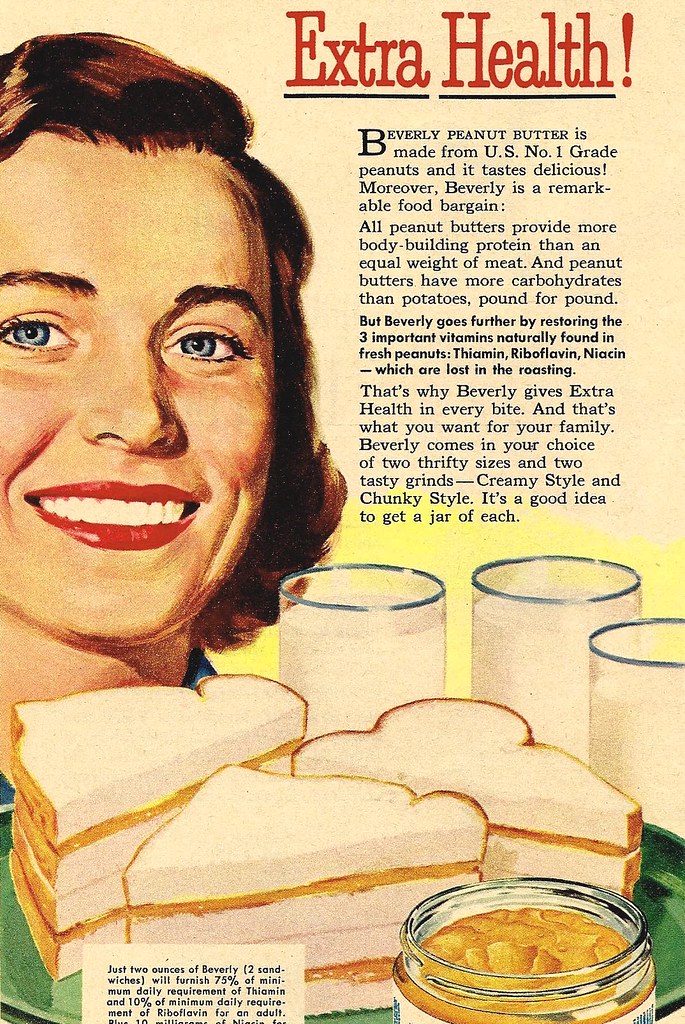
Despite the hoo-ha you hear about George Washington Carver inventing peanuts and/or butter (also being famous for carving up George Washington), peanut butter, according to an informative article at Slate, has been around for a while, delighting young children and the protein-starved for centuries (Carver, to be fair, helped modernize and popularize peanut-growing techniques). The Aztecs were first to put peanuts to grindstone, and it was popularized in 1897 by J.H. Kellogg, a psychiatric doctor who developed a patent on it (Kellogg, btdubs, is the creator of the eponymous Kellogg cereal, which he would give his patients. He discovered the crunch-crunchiness of the hard cereal helped make his patients more responsive, and marketed the cereal as a breakfast food designed to wake you up. The More You Know*). It started making its way onto tables big time after World War II led to a drive for more protein, and peanut butter delivered. Cue 1950's-era cheerful ads depicting moms making peanut butter sandwiches for chubby kids. A star was born.


Since then, peanut butter has become as American as apple pie, which, ironically, would not be improved if you added peanut butter. Jif, the largest peanut butter company in the world, churns out 250,000 jars a day (a day! that is crazy!). March is National Peanut Butter Month, to be celebrated by, I guess, eating peanut butter? The Peanut Butter Lovers Club says you should tell your friends Americans eat about 3 pounds of peanut butter every year and peanuts are actually not nuts at all! So. Um. Go tell your friends.

For eats, you really can't do much better than peanut butter. Mixed with chocolate or spiced up into a sauce, it's always pretty amazing. (of course, there is also pb's favorite partner, j, as in jelly. I actually wouldn't know what a pb&j tastes like because I've never in my life eaten one. I know how that sounds).

I leave you with my favorite peanut butter recipe, peanut butter fudge, which is basically regular peanut butter + butter and sugar. Enjoy!


PEANUT BUTTER FUDGE, FROM Doris E. Hashman OF Columbus, OH
INGREDIENTS:
2 cups granulated sugar
1 cup milk
1/2 stick margarine
pinch of salt
1 cup peanut butter
1 teaspoon vanilla

DIRECTIONS:
Mix sugar, milk, margarine and salt in a saucepan.
Boil, stirring frequently, until it forms a soft ball in cold water.
Remove from stove and add peanut butter and vanilla.
Beat until creamy and pour into buttered 9x9 pan.
Let cool before cutting.


Read more!