Showing posts with label La Cocina Espanol. Show all posts


La Cocina Espanol: Pollo al Ajillo

One of the best meals we cooked in Spain was, coincidentally, also the first. It was also not made by me. Our first night in our casita in the mountains, I was feeling woozy and headachey and tired, so Dave told me to take a shower, have a cup of tea, and relax while he cooked dinner. Did I mention I am thrilled to marry this guy? Although Dave does not usually flex his culinary muscles (sometimes he cooks for me for my birthday, and that is very nice), he usually does a good job, diligently following directions and sampling to his heart's content (which means a LOT. seriously. the guy will eat anything in any state of preparedness).

Dave made me garlic chicken, another typical dish in Spain, and as soon as it hit the table my wooziness went away, to be replaced with wild, ravenous hunger. And it was soooo delicious. I love garlic and generally feel that anything can be made better with a crushed clove or two, but this was inspired: coated with a fine mix of oil and garlic, lightly salted, it was simplicity at its best, a clean, strong-tasting, utterly delicious meal. I loved how the garlic was able to shine through, balanced by a restrained sprinkling of salt. Cooking the chicken--which was also much better than what you'd find in the U.S.--released its juices, which mixed and mingled with the garlic and oil. The resulting chicken was evenly coated with the delicious mixture, more a sauce than a flavoring. It was amazing.

Eating the chicken, Dave and I both marveled how delicious it was, but also how incredibly simple. In fact, Penelope Casas said when she asked the chef at one of her daughter's favorite restaurants for the recipe, he wrote back, essentially "Cut up a chicken, pan fry in oil and garlic, sprinkle with salt, serve."

Although the chicken is perfect for a simple meal (I could see these going fast at a picnic or tucked into a sandwich), it's a little too bare-bones for anything very fancy. In Spain, we had just the chicken, since Dave was so focused on the one meal he forgot the potatoes we also meant to eat, and it was good if bordering on bland. A few days ago, we recreated the meal, this time adding patatas bravas, the Spanish version of French fries which we downed at most tapas bars. Although our chicken dried out a little more than we wanted (poor timing--save the chicken, which cooks up in less than 10 minutes--for the end), it still paired wonderfully with the potatoes and the spicy, tangy patatas bravas sauce.

POLLO AL AJILLO
INGREDIENTS
2 chicken breasts, diced
2 tablespoons olive oil
7-10 cloves of garlic, crushed
salt to taste

DIRECTIONS
Heat oil over medium heat in a large pan
Add chicken and cook until no longer pink
Add garlic and lower heat
Cook chicken until golden on both sides
Remove from pan and sprinkle with salt

Image from mundorecetas.net

Read more!


La Cocina Espanol: A Brief History of Paella

My favorite line in Penelope Casa's The Food and Wines of Spain (aka my and Dave's foodie bible while traveling) is a quote from a Spanish food critic in response to canned paella:

"Canned paella?! How can you can paella? It's like trying to can the sun...or poetry!"

Spaniards take their paella seriously, and reading Casa's book, I learned to take it seriously, too. The paella rules? ONLY to be eaten where you can see the ocean, ONLY in Valencia--Spanish rice country, and ONLY with fish and seafood that was swimming about 30 seconds prior to dropping in the pan. She also strongly encouraged readers to seek out paella made directly on the fishing boats where the fish are caught, a process that places so much emphasis on freshness that even sitting in a restaurant is too far away and paella purists must instead gather on the beach like waiting seagulls. However even she contended that this was maybe going a little too far.

Paella was born in Valencia, where the ubiquitous rice paddies dot an otherwise arid region. Named for the Catalan word for pan, paella is seasoned with saffron, a spice found in many Spanish dishes due to the Moorish influence in the country. Although I was most anxious to try seafood paella, the dish's popularity throughout Spain means there are myriad varieties, from Valenican paella, which is made with rice, beans, green vegetables, and meat, to paella flavored with chicken or lobster. A sign of a good paella is that it's served directly in the pan in which it was cooked, rather than scooped up from a communal pot. The paella should be crispy on the bottom, and warm throughout, cooked together with the rice and meat or seafood to allow the flavors to properly mix.

The first time I went to Spain, when I was 16 (I think? oh memory), my family and I ate paella at an outdoor restaurant in Madrid. It was not pleasant. Although you can smoke pretty much anywhere anytime in Europe, outdoor eating tends to attract the greatest plumes of smoke, and I was unfortunately sitting behind a woman who courteously blew her smoke away from her tablemates and onto my face. After I convulsively hacked away, she eventually realized what was happening, apologized, and stopped, but my first memories of paella are mostly clouded (heh) by that unfortunate experience. Later, I would learn that in breaking all the paella rules, the giant pan my family dug into with gusto was, in all likelihood, subpar. I think I probably ordered chicken anyway.

So when Dave and I arrived in Spain, I vowed to make amends and give paella another try. Valencia was on our list of places to visit, but at the last minute we decided to veer off for a day trip to France (we ended up driving for many, many hours, seeing a castle, and spending a night in a very hot and very cheap hotel). Although I was disappointed I couldn't sample (and steal) some of the long-grained Spanish rice Casa rhapsodized in her book, my dreams of eating paella cerca del mar were revived our last few nights in Spain, when we visited the city of Tarragona.

Tarragona, a Catalan city built by the Romans, sits on the Mediterranean a few hours north of Valencia. Although it lacks Valencia's famous rice paddies, it's full of wonderful seafood places, which means paella is almost a requisite for most restaurants. We visited one our first night there, where Dave finally got his pulpo (octopus. I know.) and I dug into a plateful of paella. My first impressions were not so great. It tasted mushier than I'd thought it would, with the rice thicker and more like risotto. The restaurant also skimped on the seafood, decorating the dish with lovely--and empty--cockle shells. I took that to mean I could do better, and so I don't hold the world of paella responsible for my two less than pleasant meals.

Still, even through the paltry seafood and the sticky rice, I could taste faint glimmers of loveliness. The rice, flavored with saffron, had brief moments where it was comfortingly warm and fragrant, filling without being weighty. Paired with fresh, fresh seafood--rich, sweet, faintly alive seafood--I saw how the dish could really taste. If anything, my disappointing meal has left me even hungrier for real paella, a shame since Casa is unsurprisingly disdainful of American mock-ups. Such is the price of perfection!
Read more!


La Cocina Espanol: Entrecot con Queso Cabrales

One of the last meals Dave and I put together ourselves (well, I put it together, but Dave helped in other ways about which I'll elaborate later) was steak in a blue cheese sauce made from the local pungent, delicious cheese: queso cabrales. I have always had a special fondness for blue cheese, which is a cheese you can't mess around with, and the queso cabrales variety did not disappoint. Made from cow's milk mixed with sheep and goat's milk, it is a true regional speciality (only cheese made from herds in Asturias--the region where we were staying--wrapped in leaves and aged in mountain caves, can be called queso cabrales). That meant one very good thing and one very bad thing, namely, (the good) that the cheese we had was so delicious and unique that it was truly an amazing experience to eat and (the bad) it is utterly, ridiculously impossible to find and enjoy anywhere else.*

We first sampled the cheese in a restaurant in Potes, the largest town near our house. I'd been looking forward to sampling local cheese for days (we passed a queseria--a cheese shop--and I almost yanked the wheel out of Dave's hands to stop there) and was delighted to find the restaurant offered a cheese plate as a tapa. When we finally got the platter, overflowing with about 8 different varieties (cue glazed eyes, watering mouth, romantic music), we wished there was some kind of guide to show what we were eating, since the cheeses were so distinct and delicious we were curious as to know what they all were. The queso cabrales, though, was immediately distinguishable, being the only blue cheese on the platter. We both sampled some, loading a little on a piece of bread, taking a tentative bite, and sitting back in our chairs like we'd been punched in the face. Queso cabrales is strong, especially in comparison to the mild goat and sheep's cheese that also scattered the plate. The sharp pungency of blue cheese was especially evident here, where each tiny bite released a cloud of distinct aroma. Dave decided that it was a little too strong for him (he favored a smoother goat cheese along with a block of apple honey jelly), but I was intrigued.

Thumbing through our Spanish foods cookbook, I found a recipe for steak and queso cabrales that I knew we had to try. I love love love steak paired with fine cheese (I still idly dream of a filet mignon topped with gouda that Jenna and Steve served at their rehearsal dinner...)--the charred and smoky meat is enriched by the salty fattiness or sharp flavors of the cheese. While Dave campaigned for seafood--for some reason he really wanted some octopus--I argued that we were far from the ocean, in cow country, with access to a delicious cheese we couldn't find anywhere else in the world. Defeated yet hungry, he agreed.

The steak was to be pan-fried and drenched in a sauce made from lemon juice, white wine, paprika, and melted queso cabrales. Ok, this sounds pretty easy and, in fact, it probably could have been. The only problem was that the recipe called for a very small amount of white wine, leaving me and Dave with most of the bottle, plus the entire bottle of red we'd bought for the meal. Since we were leaving the next day and facing the prospect of downing a bottle of wine each, we hit it early, hoping to get rid of the white before dinner and leaving the red for a leisurely meal. To summarize, 2 bottles of wine + 2 Americanos + 2 empty stomachs + 1 long day filled with hiking in the sun + hot pots and pans = not a good idea. We are lucky we didn't burn down the house, let alone end up with a halfway edible meal. I think the real problem was, without any measuring spoons, I was left to guess some sort of workable ratio for the liquids to cheese, which left the sauce far too liquidy for my tastes. Also, my normal methods for pan frying steak--stick it in a warm oven first for 2-3 minutes--were thrown off without an oven, and I had to resort to the messy and smoky method of turn up the heat and get out the kitchen.

While the end result in Spain tasted ok, I knew with closer attention to the ratios I could end up with something creamy and delicious. Yesterday, I visited the supermarket to see what kind of queso cabrales substitute I could come up with. I went with a basic crumbled blue cheese, which came nowhere near close the sharpness of queso cabrales, but at least still preserved the musty, distinct odor of blue cheese. Carefully measured and melted, the sauce came out so so good: thick and creamy, tangy and full. The meal also benefited from my vastly improved methods for pan-frying steak (I used low heat, a thick steak, and a very good pan). The steak in of itself was delicious--lightly seared edges giving way to a tender and buttery center--but coated with a layer of the cheese sauce became something entirely unique, if not quite the epicurean delight of the real thing.


ENTRECOT CON QUESO CABRALES
INGREDIENTS:
1/4 pound queso cabrales or crumbled blue cheese
4 teaspoons white wine
1 teaspoon lemon juice
1 clove garlic, crushed
dash paprika
dash pepper
steak, at least 1 inch thick
clarified butter for frying

DIRECTIONS:
About an hour before cooking, season sides of steak with salt and paper, cover in paper towels, and sit out at room temperature
In a double boiler, melt the cheese and add the white wine, lemon juice, garlic, paprika, and pepper.
Stir constantly until all the cheese is melted and the sauce is creamy
Place steak into oven and turn heat on to about 200 degrees
3-4 minutes later, remove steak from oven and place on a heavy-duty, buttered frying pan over medium heat
Cook untouched for about 4 minutes
Flip and cook for another 4 minutes, then another 90 seconds on each side
Remove steak from heat, drizzle with cheese sauce, and serve

*As with most things, thanks to the magic of the Internets you can order queso cabrales online. It is, wait for it, $137 for 6 pounds at Gourmet Food Ideas. Dave and I got a pound in Asturias for about 6 euro.

Read more!


La Cocina Espanol: A Brief History Of Sidra

Although my year+ of working at a pub taught me to appreciate beer in ways no college-kid kegger could, it's still not the first thing I reach for at a bar. I'm not quite the girly-girl smackin' on her Smirnoff Raspberry or downing appletinis (unless I'm at a Scrubs theme party), but I might lean towards a white wine if it's a nicer place or maybe a Sam Summer if we're in Boston.

So I was intrigued when we got to Basque country and Dave started talking about sidra, a hard cider native to the region. I like American hard cider (I favor Original Sin), but I was completely blown away by sidra and could have happily smuggled bottles and bottles of the stuff through customs had I not been scared by Rebecca's story of her own attempts to transport beer (smashed bottles, alcoholic luggage, angry fellow passengers). It was less sweet than American hard cider, but tangier, fresher, and more bitingly alcoholic--I could have had it breakfast, lunch, and dinner, and probably would have, too, as the siderias where it's served were open all day.

My love for sidra is so profound that I was not even terribly embarassed by my and Dave's sidra faux pas the first time we drank it. We had arrived in San Sebastian, a coastal town not far from Bilboa, and exhausted and hungry, asked the hotel to direct us to the closest bar. Muching on pinchos (sandwiches), we asked the bartender for a bottle of sidra. He obligingly got one from the fridge, uncorked it, and stuffed a small green spout in the mouth. Dave immediately removed the spout, poured our drinks, and we clinked glasses and enjoyed. It tasted good--refreshingly appley if a little flat--and we finished the bottle, paid our check, and headed back to the hotel, not even questioning what that little spout was for.

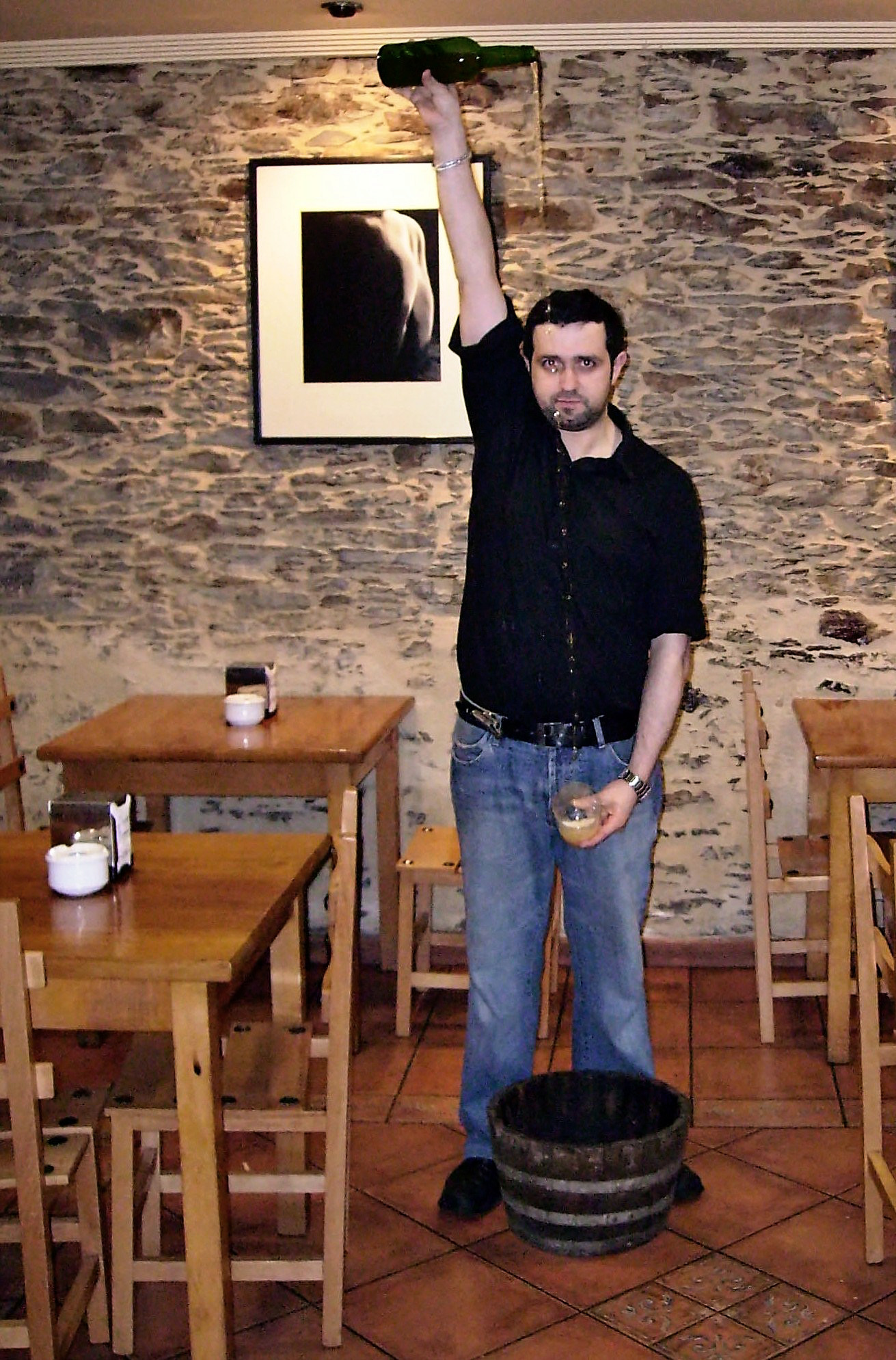
Days later, we discovered our error: sidra, as enjoyed in Basque country, is poured into a glass held about 3 feet away from the bottle. Once it splashes in the glass (if you're good enough to actually aim it into the glass), it releases tiny bubbles that churn the cider, unleashing a flood of rich, unique taste. The difference between our quietly poured glasses and the fizzing, splashing, correctly-poured sidra was like the difference between flat Coke and regular--no comparison, it was just so much better. The bubbling added a rich texture and complexity of flavor, allowing the odor of fresh apples to better reach your nose. While sidra on its own is pretty good, fizzy, bubbly, messy sidra is utterly amazing.

Like any good regional drink, the amount of care and thought put into crafting, pouring, and enjoying sidra was amazing. In Asturias, we came across strange contraptions with shelves and hoses mounted to the walls of bars. Asking for a glass of sidra, we saw the thing in action: a machine designed to fizz up the drink and drop it into the glass without making a giant mess. Because the truth is, sidra is messy to drink. The precision needed to pour it into a glass is ridiculous (for days I thought it couldn't be that hard, until Dave allowed me to try it a few times. About three drops landed in the glass), and even pros concede a few splashes will hit the floor. If it wasn't so delicious, I would have even wondered whether the pour from above thing was just a ruse made up by enterprising siderias that wanted to sell more bottles--afterall, you lose at least a glass of the stuff through pouring.

Because sidra is made only in special farm/restaurants called sagardotegi, it's not sold in the U.S. or even in most parts of Spain. Bottled, it can last about a year, but since it must stay cool, it's almost exclusively drunk in northern Spain (some Basque restuarants will serve sidra, though, like one we found in Tarragona). Still, if you do make it up to the northern regions of Spain, sidra will almost certainly be the most popular drink available, bubbling and fizzing its way into your heart.
Read more!


La Cocina Espanol: Tortilla de Patatas

When Dave and I finally arrived at our lovely little casita de madera in Villaverde, a town of approximately 20 people near los Picos de Europa national park, I was pleasantly pleased to discover we had a well-stocked little kitchen. No oven or fancy cookware, but a nice supply of the basics: two electric burners, wide sink, array of pots and pans, tiny fridge--perfect for our 5-day stay. For the whole trip, I'd been anxiously looking forward to getting out there to cook, but when game time rolled around, I totally dropped the ball, spending our first night sprawled out on the bed, headachey and carsick from several hours of driving on winding mountain roads (Dave eventually learned to be a mountain-driving pro, but that first day... phew...). Luckily, my funny honey put together a delicious, fantastic meal (chicken in alioli, or garlic, sauce) that left both of us impressed, but rather than starting the Spanish food posts with that, I'm going with the quintessential Spanish meal, and the first Spanish food I cooked: the humble yet delicious potato omelet.


The potato omelet, or tortilla de Espana, is a large, fluffy, and potato-stuffed, resembling more quiche than American omelet, which is thin and flat in comparison. It also has little to do with the American tortilla, a flatbread made from corn or wheat. You can get a tortilla de patatas in any bar in Spain, usually for lunch or dinner (breakfast in Spain consisting of little more than tea or coffee with a croissant or hot chocolate with churros), but it's not too difficult to make (unless you are una Americana trying it for the first time).

As usual, I followed the directions in Penelope Casas' The Food and Wines of Spain, which Dave and I pored over for the extent of the trip (she will get her own post in due time). Since the instructions were, essentially, slice and fry potatoes, beat eggs, fry and flip, I figured we would be on easy street (I was also hampered by not having a referential photograph). My tortilla de Espana turned out a little thin, a little crumbly, but quite delicious, with the sweetly charred potato bits setting off the simplicity of the eggs. In truth, it looked like any typical American potato omelet rather than the thicker, cakier version in Spain. Since I only discovered this upon my return to the homeland, and it tasted good anyway, Dave and I feasted, pleasantly naive.

Upon further research, I would suggest beating the eggs until they are very, very fluffy and doubling the number you think you would want (Dave and I went with four eggs, but should have either used a smaller pan or gone with 6-8). This will help the eggs rise a few inches and the potatoes to set evenly. Also, when cooking the potatoes, try to think of it as boiling in oil, rather than frying. The potatoes should be soft and loose, not cooked together (frequent stirring helps). I heavily garlicked my oil, since I love garlic, and omitted the onions, since I don't love onions. Flipping the tortilla also seems to be one of those things you need practice (and courage) to do correctly (and even then you might run into some trouble. See Child, Julia).

TORTILLA DE ESPANA
INGREDIENTS:
1-2 tablespoons olive oil
2-3 gloves of garlic, peeled and lightly crushed
1-2 large potatoes, washed, peeled, and sliced
8 large eggs
salt and pepper to taste

DIRECTIONS:
In a large frying pan, heat oil over medium-high heat until rippling
Add garlic, periodically crushing with a large spoon
When garlic is very lightly browned, remove and throw away
Add potatoes, stirring frequently until they are soft and thoroughly cooked
Remove potatoes and pour out oil (it can be saved and reused if you like)
Beat eggs until light and fluffy (a small amount of milk can be added, if desired)
Add potatoes to egg mixture and cook over medium-high heat for about 15 minutes
Using a plate or wide spatula (or your own wits), flip tortilla and cook the other side
When thoroughly cooked, flip again; both sides should be well-browned
Remove from pan and season with salt and pepper
Read more!